Productivity Impact
Reduction in screening time with AI assistance
Resumes processed per session with bulk upload
Evaluation criteria across all candidates
At a Glance
AI-Assisted Screening
- Processes resumes in seconds
- Consistent evaluation criteria
- Scales with volume
- Provides ranked shortlists
- Works 24/7 without fatigue
Manual Review
- 2-5 minutes per resume
- Varies by recruiter and fatigue
- Linear time scaling
- Subjective prioritization
- Quality degrades with volume
Detailed Comparison
| Aspect | AI-Assisted | Manual Review |
|---|---|---|
| Time per Resume | Seconds for initial screening | 2-5 minutes per resume |
| Consistency | Same criteria applied to every resume | Varies based on recruiter fatigue and bias |
| Scalability | Process 100+ resumes in minutes | Linear scaling—more resumes need more time |
| Context Understanding | Semantic analysis of qualifications | Human intuition and industry knowledge |
| Nuanced Decisions | Provides scores and rankings | Can make complex judgment calls |
| Candidate Experience | Faster response times possible | Personal touch in communications |
The Case for AI Assistance
Manual resume review has been the standard for decades, but it doesn't scale. When a job posting attracts 200 applications, a recruiter spending just 3 minutes per resume faces 10 hours of screening work. That's before considering the inevitable fatigue that affects evaluation quality.
AI-assisted screening doesn't replace the recruiter's judgment—it handles the time-consuming initial filtering. Instead of reading every resume from start to finish, recruiters receive a ranked list with match scores. They can then focus their expertise on the most promising candidates.
Where Human Judgment Still Matters
AI excels at consistent, scalable analysis. But hiring decisions involve nuances that benefit from human judgment:
- •Cultural fit and soft skills assessment during interviews
- •Understanding career context (gaps, transitions, growth trajectory)
- •Industry-specific knowledge and market conditions
- •Final hiring decisions with stakeholder input
The most effective approach combines AI efficiency with human expertise. AI shortlists; humans decide.
See AI-Assisted Screening
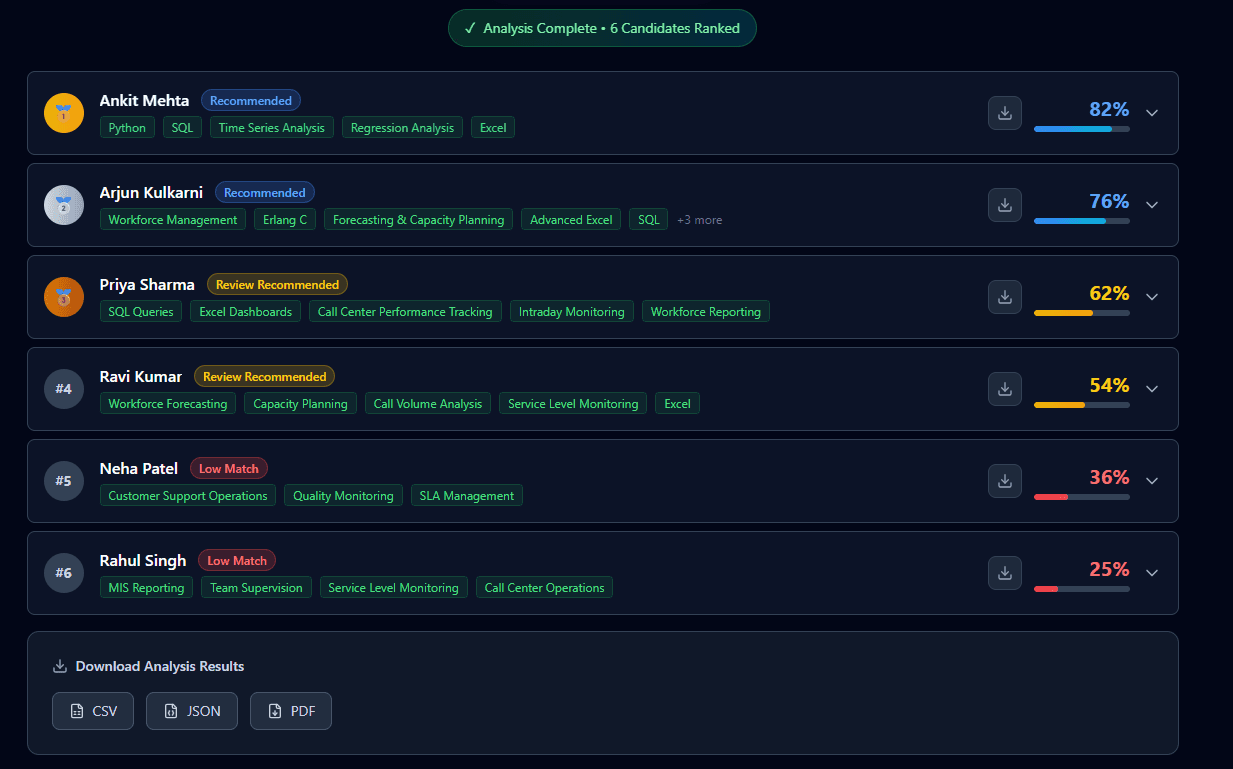
Ranked Shortlists for Human Review
AI provides match scores and rankings. Recruiters spend their time evaluating the most promising candidates instead of filtering through unqualified applications.
Manual Review Challenges
Time Intensive
Manual review of 100 resumes takes 3-8 hours. This creates bottlenecks in time-sensitive hiring.
Fatigue Effects
Recruiter attention and evaluation quality degrades after reviewing many resumes. Early candidates get more thorough reviews.
Inconsistency
Different recruiters apply different criteria. Same candidate might pass or fail depending on who reviews them.
AI Assistance Benefits
Initial Filtering
AI handles the time-consuming first pass, ranking candidates by match score so recruiters focus on the most promising applicants.
Consistent Evaluation
Every resume is evaluated against the same job requirements, ensuring fair comparison across all candidates.
Human + AI
AI provides data-driven insights. Recruiters make final decisions with better information, not less.
The Bottom Line
AI-assisted screening and manual review aren't mutually exclusive. AI handles the high-volume initial filtering with consistency and speed. Recruiters apply their expertise to make nuanced decisions on shortlisted candidates. This combination reduces screening time by up to 80% while maintaining—or improving—hire quality.