The High-Volume Screening Challenge
Time Bottleneck
Manual screening of 500 resumes can take 40+ hours. That's a full week of recruiter time lost to administrative work.
Volume Overload
Campus drives and hiring campaigns generate hundreds of applications that need quick processing.
Inconsistent Evaluation
After reviewing hundreds of resumes, fatigue sets in. Later candidates may not get the same attention as earlier ones.
Understanding the Scale of the Problem
When you're staring at a folder of 500 resumes, the traditional approach—opening each one individually, scanning for keywords, making notes—becomes unsustainable. Even at just 2 minutes per resume, that's over 16 hours of continuous screening. In reality, with context switching and fatigue, it takes much longer.
For recruitment consultancies handling multiple clients simultaneously, this creates a significant bottleneck. Campus drives, seasonal hiring campaigns, and rapid-growth companies can all generate hundreds of applications in days. The traditional manual process simply wasn't designed for this scale.
The impact extends beyond just time. Recruiter fatigue leads to inconsistent evaluations—candidates reviewed at the start of the day often receive more thorough consideration than those reviewed after hours of continuous screening. This inconsistency can result in missing strong candidates or, worse, unfair treatment of applicants.
How AI Changes the Equation
AI resume screening tools like Empikalyze take a fundamentally different approach. Instead of manually reading each document, you upload your job description and all resumes at once. The AI then analyzes each resume against your requirements using semantic matching—not just keyword spotting, but understanding the context of skills and experience.
This contextual understanding is crucial. A traditional keyword filter might miss a candidate who writes "React development for 5 years" if you're searching for "frontend developer with React." Semantic matching understands these equivalencies, surfacing qualified candidates that keyword systems would overlook.
The result is a ranked list of candidates, each with a match score indicating how well they align with your job requirements. Instead of reviewing 500 resumes sequentially, you can focus on the top 50 matches first, confident that the AI has already done the initial filtering.
The AI Screening Workflow
Define Your Requirements
Upload or paste your job description with all requirements. Include skills, experience level, and any specific qualifications you're looking for.
Bulk Upload Resumes
Upload up to 100 resumes per batch in PDF, DOCX, DOC, or TXT format. For 500 resumes, you'd process them in 5 batches.
AI Analysis
AI analyzes each resume against your job requirements using semantic matching, understanding context beyond simple keywords.
Get Ranked Results
Receive a prioritized list with match scores for each candidate. Focus your review on the highest-scoring applicants first.
See AI Screening in Action
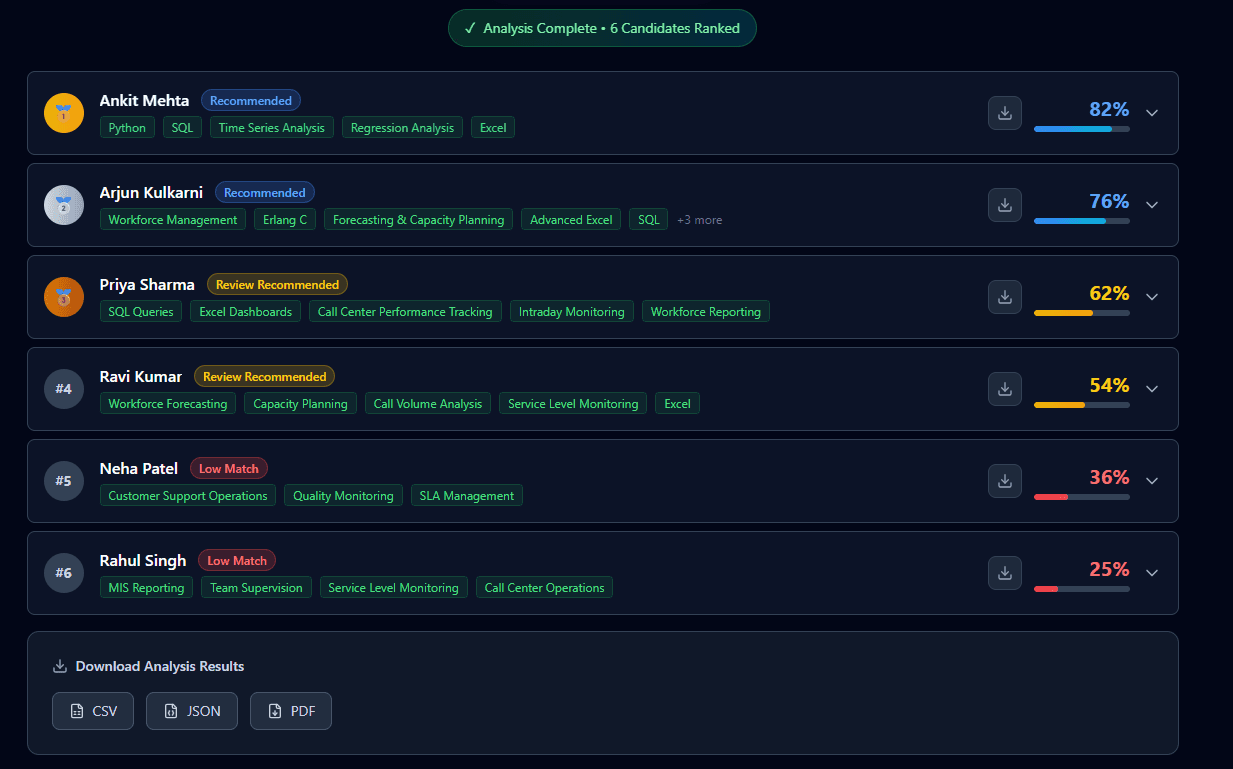
Ranked Candidates in Minutes
From 500 resumes to a prioritized shortlist. Each candidate gets a match score based on how well their qualifications align with your job requirements.
Best Practices for High-Volume Screening
Success with high-volume screening isn't just about having the right tools—it's about using them effectively. Here are key practices that can help you maximize efficiency while maintaining quality.
Start with a Clear Job Description
- Document must-have vs nice-to-have skills separately
- Include specific experience requirements
- Mention any certifications or qualifications needed
Process in Manageable Batches
- Upload 100 resumes at a time for optimal processing
- Review results between batches to refine criteria if needed
- Keep track of which batches you've processed
Focus on Top Candidates First
- Review highest-scored candidates before moving down the list
- You may find your ideal candidate in the top 10%
- Don't feel obligated to review every single resume
How AI Screening Helps
AI-Powered Analysis
Upload up to 100 resumes at once. AI analyzes each one against your job description in minutes.
Ranked Shortlists
Get candidates ranked by match score. Focus your energy on the most promising applicants first.
80% Time Savings
Reduce screening time by up to 80%. Spend more time interviewing and less time filtering.
Related Articles
How Recruiters Shortlist Resumes
Learn the complete resume shortlisting process from keyword filtering to semantic matching.
Bulk Resume Screening Guide
Master bulk screening for campus drives and hiring campaigns with proven strategies.
AI Screening vs Manual Screening
Compare productivity and accuracy between AI-assisted and traditional manual review.
Bulk Resume Screening Tool
Explore Empikalyze's bulk upload capabilities for high-volume hiring scenarios.