
Recruiters often receive hundreds or even thousands of resumes for a single position. Reviewing every application manually is time-consuming, inconsistent, and difficult to scale.
AI Resume Screening uses artificial intelligence to analyze resumes, compare them with job requirements, and help recruiters identify candidates who deserve closer review.
Modern AI screening goes beyond simple keyword matching. It can understand skills, experience, education, job titles, and contextual relationships to provide more meaningful candidate recommendations.
The objective is not to replace recruiters. Instead, AI helps recruiters focus their time on evaluating the most relevant candidates while maintaining human decision-making throughout the hiring process.
Want to see what AI screening output actually looks like? The screening benchmarks page compares real job descriptions, resumes, and actual Empikalyze AI screening results side by side.
Try it while you read
Run the screening workflow yourself in the free playground on the Empikalyze homepage — one job description and up to 6 resumes (PDF or DOCX), three runs per day, no signup required. Prefer a guided test with your own batch? Request the free pilot.
What is AI Resume Screening?
AI Resume Screening is the process of using artificial intelligence to analyze resumes and assist recruiters in identifying candidates who best match a job description.
The system evaluates multiple aspects of a resume such as professional experience, technical skills, education, certifications, job titles, and other relevant qualifications before generating candidate insights.
Unlike traditional keyword filters, modern AI screening systems can evaluate contextual relationships between skills and experience, allowing recruiters to discover qualified candidates that simple keyword searches may overlook.
How AI Screening Works, From JD to Ranked List
A modern screening workflow moves through a small number of predictable steps. Understanding them helps recruiters judge output quality and set up jobs correctly.
- The recruiter defines the requirement. A complete job description is added — pasted or uploaded — along with an optional note (for example, “must be based in Bengaluru” or “client prefers candidates from BFSI”). Clearer requirements produce more useful evaluations.
- Resume content is prepared. Text is extracted from each resume file. In Empikalyze’s production pipeline, personally identifiable information such as phone numbers and email addresses is removed from the resume content automatically before anything reaches the AI model.
- The AI evaluates evidence, not keywords alone. The model reads the sanitized resume against the requirements and assesses skills, relevant experience, education, and context — using only evidence actually present in the resume.
- Results are validated and ranked. Structured outputs are checked for completeness (score range, experience classification, field limits) before acceptance, then candidates are ranked so the recruiter starts with the strongest matches.
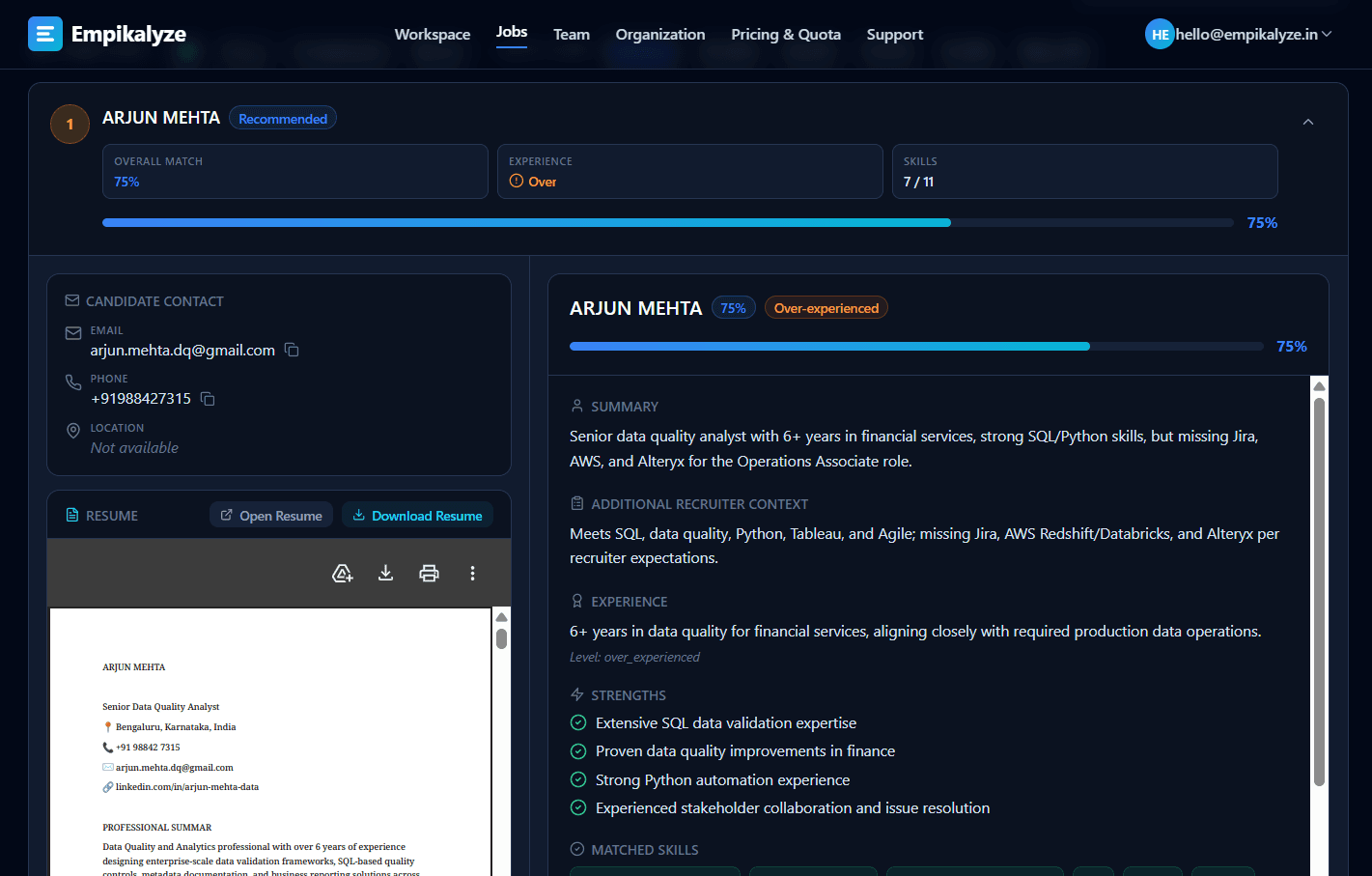
- The recruiter reviews the shortlist. Each result carries its score, matched and missing skills, strengths, and gaps — the evidence a recruiter needs to accept, question, or override the ranking.
The pipeline above mirrors what Empikalyze documents publicly on its How It Works page, and the same stages are illustrated with real output on the benchmarks page.
AI Screening vs Keyword Filters and ATS Workflows
Keyword filters were the first wave of screening automation: find the resumes that contain “Java” and “Spring Boot”, discard the rest. They are fast, but they fail in both directions — a strong candidate who wrote “J2EE and Spring framework” is missed, while a weak candidate who stuffs keywords passes.
AI screening reads meaning and context. It recognizes that Spring Boot implies Java, that a “team lead” who “mentored two juniors” has some leadership evidence, and that a two-month certification is not equivalent to four years of production experience. For a deeper comparison, read the Semantic Matching guide.
An applicant tracking system (ATS) is a different category of tool. ATS platforms manage the hiring pipeline: applicants, stages, interviews, communication, and reporting. AI screening is a focused evaluation step that can sit before or alongside an ATS. Empikalyze deliberately does not try to replace an ATS — it targets the most time-consuming step, screening and shortlisting.
Why Recruiters Use AI Resume Screening
Recruitment teams face increasing application volumes while hiring timelines continue to shrink.
AI Resume Screening helps recruiters:
- Reduce manual resume review time
- Improve consistency during candidate evaluation
- Prioritize qualified candidates faster
- Handle high-volume recruitment campaigns
- Support recruitment agencies managing multiple client requirements
- Allow recruiters to spend more time interviewing and engaging candidates
Resume Screening for Indian Recruitment Agencies
Indian consultancies and staffing firms often juggle many client requirements at once, with application volumes that swell through job portals like Naukri and LinkedIn. Three patterns come up again and again:
Screening a Java developer batch
A client needs a Java developer with 3–5 years of experience, Spring Boot, and AWS. Forty resumes arrive. Keyword matching rewards anyone who lists the words; AI screening separates a candidate who has built and run Spring Boot services in production from one who completed a certification project, and surfaces the strong backend engineer whose resume says “J2EE, Hibernate, REST APIs” without ever using the exact phrase “Spring Boot”.
Screening for a sales executive role
Sales resumes hinge on outcomes — targets achieved, territories covered, industries served. AI screening can weigh “managed a team of 6 field sales executives in tier-2 Andhra Pradesh” as relevant leadership evidence for a regional sales role, and flag the missing evidence (say, no B2B exposure for a B2B mandate) instead of silently rejecting the candidate.
Screening customer-support applications
High-volume support hiring often means hundreds of similar resumes. Consistency matters: the twentieth resume should be evaluated against the same criteria as the first. AI screening applies the same requirement set to every applicant, which reduces the drift that tired manual reviewers naturally develop — while the recruiter keeps the final call on communication skills and fit.
In all three cases the goal is the same: a defensible shortlist the recruiter can explain to the client — score, skills, strengths, and gaps for every candidate.
Writing a Job Description with Clear Must-Haves
AI screening is only as good as the requirements it is given. A few practical habits make a large difference:
- Separate must-haves from nice-to-haves. If a skill is genuinely mandatory, say so. Preferred skills should stay preferred — good screening will weigh them without rejecting candidates who lack them.
- Quantify experience where it matters. “3–5 years building and operating REST APIs” is more usable than “relevant experience required”.
- State context constraints explicitly. Location, notice period, work authorization, or shift expectations belong in the description or the recruiter note — AI cannot infer client constraints nobody wrote down.
- Avoid inflated wish lists. A description that demands fifteen technologies for a junior role produces weak separation between candidates; every result looks like a partial match.
Need help structuring a description? The free JD Keyword Extractor pulls required skills, tools, certifications, and responsibilities out of any job description into a structured list.
How to Validate AI Screening Results
A match score is a prioritization signal, not a verdict. Practical validation habits:
- Read the evidence, not just the number. Open the matched and missing skills, strengths, and gaps. A 78 with the exact gaps your client can live with beats an 82 missing the single non-negotiable skill.
- Spot-check the extremes. Review the top few and a couple from the bottom. If the bottom looks wrong, the requirements are probably unclear — fix the job description rather than manually re-ordering results.
- Watch for resume inflation. AI reads what is written; verify claims that decide the hire (employment dates, degree, certifications) during interviews and reference checks.
- Keep the human decision. Empikalyze never auto-rejects or contacts candidates — every shortlist decision stays with the recruiter.
To see this review process applied to real examples with full transparency — original resumes, sanitized inputs, and actual results — explore the screening benchmarks.
Human-in-the-Loop AI
AI Resume Screening should support recruiters rather than replace them.
Recruiters remain responsible for reviewing candidate profiles, validating qualifications, conducting interviews, and making final hiring decisions.
AI provides recommendations based on available information, but recruiter expertise remains essential throughout the hiring process.
This human-in-the-loop approach helps improve efficiency while maintaining accountability and fairness during hiring.
Candidate Data and Privacy Questions Recruiters Should Ask
Screening tools process other people’s personal information, so recruiters evaluating any tool — Empikalyze included — should ask a short list of questions:
- Where are resume files and screening data stored, and who can access them? Look for organization-scoped access controls.
- Is identifying information removed before AI processing? Within Empikalyze’s resume screening workflow, personally identifiable information (PII) is sanitized from resume content before it is processed by the language model, so candidate identifiers are not part of the AI analysis step. Redaction is automated — a strong control, but not a guarantee that every identifier is removed.
- Is candidate data used to train AI models? Empikalyze does not use customer resume data to train its AI models.
- Can data be deleted on request? Organizations can request deletion of their recruitment data at any time.
- Do we have permission to process these candidates’ information? Agencies remain responsible for having appropriate consent and permission before uploading candidate data to any tool.
Empikalyze’s full positions are documented on the Data Security and Privacy Policy pages.
Coming next — Resume Library: Empikalyze is developing a Resume Library to help teams store their historical resumes in one searchable library and rediscover relevant candidates for new requirements. It is in development and not available yet — join the early-access list to hear when it opens.
Benefits
| Benefit | Description |
|---|---|
| Faster Screening | Review more resumes in less time |
| Consistent Evaluation | Apply consistent evaluation across candidates |
| Recruiter Productivity | Reduce repetitive manual work |
| Better Prioritization | Surface stronger candidate matches earlier |
| High Volume Hiring | Scale resume screening during hiring spikes |
Limitations
Advantages
- Faster resume review
- Improved consistency
- Supports recruiter productivity
- Scales for large applicant volumes
Limitations
- Should not replace recruiter judgment
- Depends on resume quality
- Requires accurate job descriptions
- Needs human review before hiring decisions