
What is Resume Screening?
Resume screening is the process of reviewing candidate resumes to determine whether applicants meet the requirements of a job opening.
Recruiters compare each applicant's qualifications, work experience, education, certifications, technical skills, achievements, and overall suitability before deciding whether the candidate should proceed to interviews.
Resume screening is one of the earliest stages of recruitment and directly influences the quality of candidates entering the hiring pipeline.
Although organizations use different hiring workflows, the objective remains consistent: identify qualified candidates efficiently while maintaining fair and consistent evaluation.
Why Resume Screening Matters
Recruitment teams often receive dozens, hundreds, or even thousands of applications for a single vacancy.
Without a structured screening process, recruiters may spend significant time reviewing resumes that do not match the position.
An effective screening process helps organizations:
- Reduce hiring time
- Improve hiring consistency
- Focus interviews on qualified candidates
- Improve recruiter productivity
- Support better hiring decisions
- Create a more organized recruitment workflow
Common Resume Screening Criteria
Recruiters typically evaluate multiple aspects of a resume instead of relying on a single factor.
Common evaluation criteria include:
- Relevant work experience
- Required technical skills
- Education
- Certifications
- Industry experience
- Job title relevance
- Career progression
- Location requirements
- Language proficiency
- Employment history
- Domain expertise
The importance of each criterion varies depending on the position being filled.
Manual Resume Screening
Traditional resume screening is usually performed manually by recruiters.
Recruiters read resumes individually, compare them with the job description, and determine whether candidates meet the hiring requirements.
Manual review provides human judgment but can become increasingly time-consuming as application volume increases.
Large recruitment campaigns often require recruiters to review hundreds of resumes within limited hiring timelines.
AI-Assisted Resume Screening
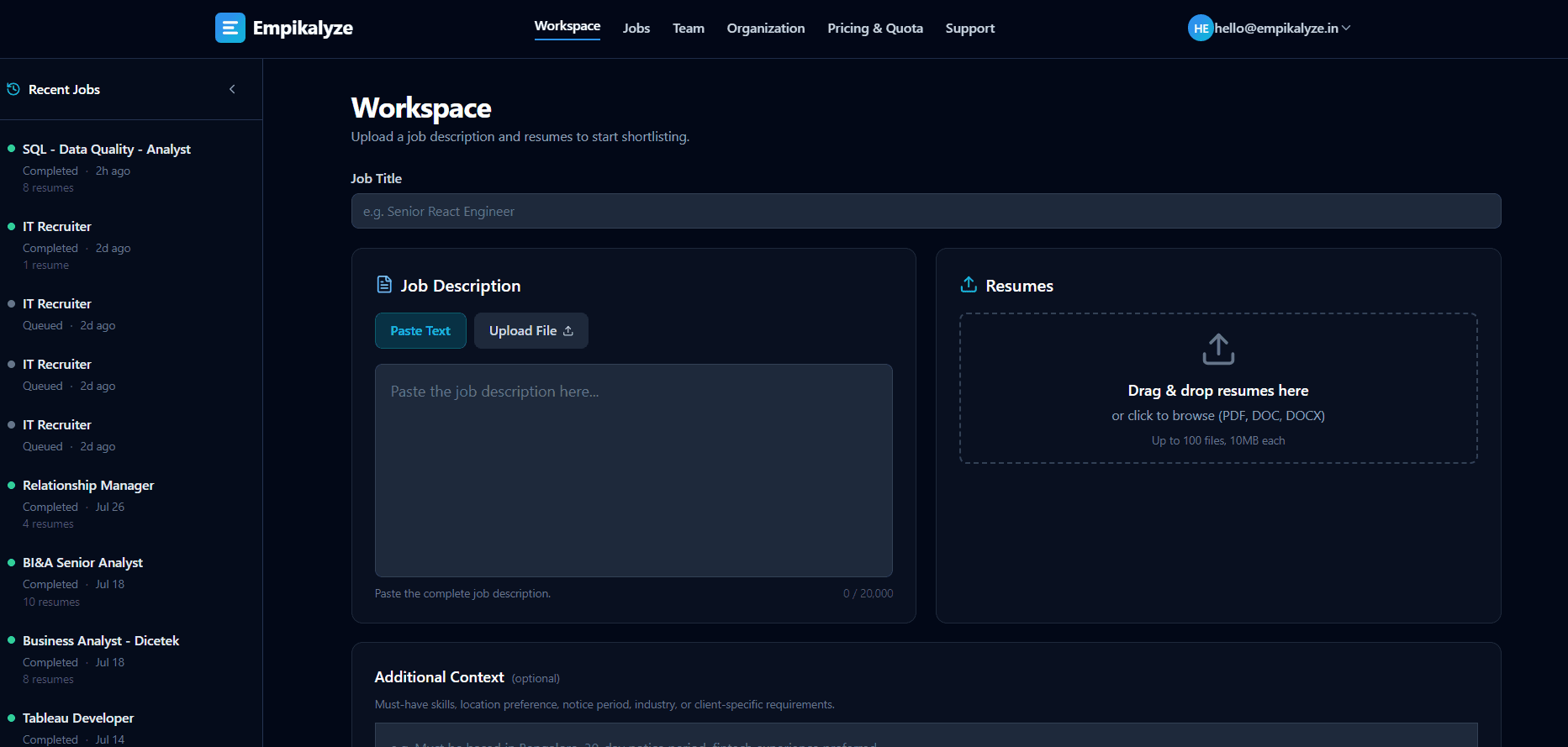
Modern recruitment teams increasingly use AI-assisted resume screening to improve efficiency.
AI systems analyze resume content, compare candidate information with job requirements, identify relevant qualifications, and organize applicants based on relevance.
The recruiter remains responsible for the final hiring decision.
AI serves as a decision-support system that reduces repetitive manual work while allowing recruiters to spend more time evaluating shortlisted candidates.
Benefits of AI-Assisted Resume Screening
| Traditional Screening | AI-Assisted Screening |
|---|---|
| Manual resume review | Automated initial evaluation |
| Time-intensive | Faster prioritization |
| Difficult to scale | Handles high application volumes |
| Variable consistency | Consistent evaluation criteria |
| Recruiter reviews every resume | Recruiter focuses on shortlisted candidates |
Best Practices
Organizations can improve resume screening quality by following several best practices:
- Define clear job requirements before screening begins.
- Use structured evaluation criteria.
- Review resumes consistently across applicants.
- Avoid relying solely on keyword matching.
- Combine recruiter expertise with AI-assisted analysis.
- Continuously review and improve hiring workflows.
Challenges
Resume screening also presents several challenges.
Common challenges include:
- High application volume
- Limited recruiter time
- Maintaining consistent evaluation
- Identifying transferable skills
- Reducing unconscious bias
- Managing urgent hiring timelines
These challenges explain why many organizations adopt AI-assisted screening technologies while maintaining recruiter oversight.
Relationship with AI Resume Screening
Resume screening describes the overall recruitment activity.
AI Resume Screening is one method used to perform resume screening more efficiently.
Not every resume screening process uses artificial intelligence, but AI-powered systems assist recruiters by automating repetitive evaluation tasks while keeping humans responsible for hiring decisions.
Resume Screening vs AI Resume Screening
| Resume Screening | AI Resume Screening |
|---|---|
| Overall recruitment activity | Technology-assisted screening approach |
| Can be manual | Uses AI assistance |
| Performed by recruiters | Supports recruiter decisions |
| Suitable for any hiring process | Best for medium and high-volume recruitment |
| Human judgment drives decisions | Human judgment remains final |
Advantages
Advantages
- Improves hiring organization
- Identifies qualified candidates earlier
- Supports better interview selection
- Helps maintain consistent evaluation
- Reduces unnecessary recruiter workload
Limitations
- Manual screening requires significant recruiter time
- Screening quality depends on evaluation consistency
- High application volumes reduce scalability
- Traditional keyword matching may overlook relevant candidates